

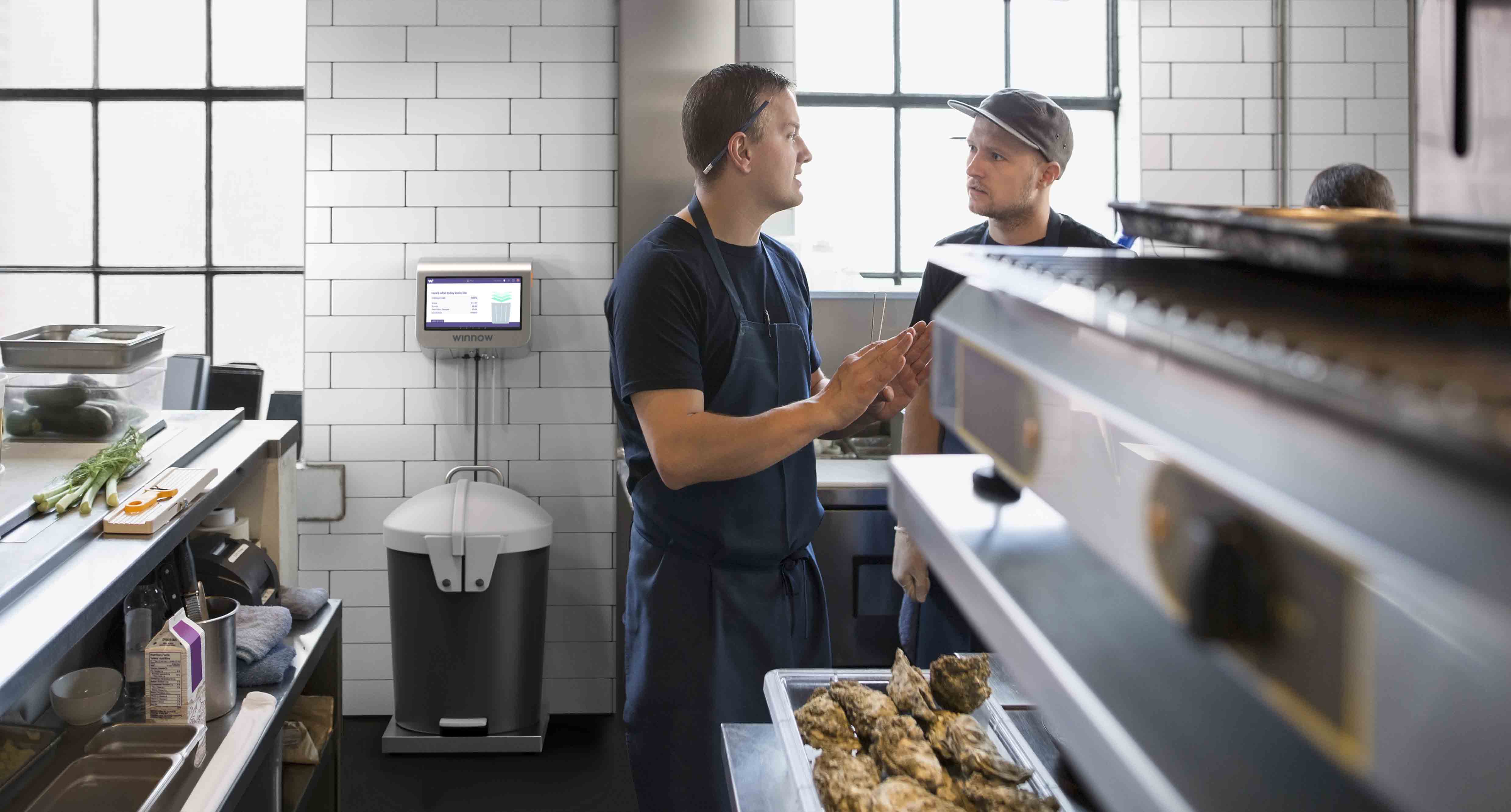
The best food waste management system for a hospitality group comes down to two design choices: where the camera sits and how much work staff must do per shift. No-touch AI capture at the bin fits multi-site operators best because nothing gets skipped mid-service. This guide compares the four main types on the criteria that decide whether a system gets used and pays back.
TL;DR: the numbers that matter:
- No-touch AI capture is the most widely deployed approach: Winnow runs in 3,500+ sites across 94 countries, more than any other platform in the category.
- Kitchens that measure waste typically cut food costs by 2-8%.
- Winnow customers collectively save over $100M per year; audited single-site results reach $165,000 a year (Royalton CHIC Cancun).
- IKEA cut food waste 54% across 500+ kitchens in 30+ countries, saving $37M.
- No-touch capture records a disposal in under one second, with no scanning step for staff.
- Typical first-year ROI: 2-10x.
Why the design choice matters for hospitality operators
Food waste data feeds critical hospitality decisions: what to order, how to build menus, how chefs run prep. That holds whether it is a resort juggling banqueting and à la carte across multiple kitchens, a cruise line running multiple galleys across a fleet, or a contract caterer managing hundreds of client sites with different menus and volumes.
The more kitchens in the mix, the more the system's reliability matters. The most detailed capture method on a spec sheet is worthless if a busy galley or a Saturday banquet kitchen skips it. The real question is whether the system records reliably, every shift, across every kitchen type in the portfolio, without adding work, and whether the vendor can show audited results across many sites consistently.
How the four types of food waste system compare
|
What to compare |
No-touch AI capture at the bin (Winnow) |
Above-bin camera capture |
Connected smart-scale weighing |
Scan-based plate and tray systems |
|---|---|---|---|---|
|
How waste is captured |
Winnow photographs food at the moment it enters the bin, capturing a burst of 30+ images per disposal and selecting the clearest frame, so each item is recorded before it reaches anything already in the bin. |
A camera above the bin records each item while a staff member holds the tray up to the camera, before it is thrown in. |
A connected scale weighs waste; item detail depends on manual selection or is weight-only. |
Staff place pans or trays on a countertop unit before and after service. |
|
Work required from staff each shift |
Throw & Go is available for Vision products. Because capture is automatic, no disposal can be skipped: staff bin food exactly as they normally would, with no scanning step to remember and no waiting with a tray held up until a scan completes. |
Staff must hold each item up to the camera at the point of disposal for it to be recorded. Not fully hands-off. |
Usually weigh and categorise each item. |
Present pans at two points in the service cycle. |
|
Data captured per disposal |
Food type, weight, cost and CO2e. Recognises 1,000+ food items, trained on 500m+ images. [DATA: published accuracy rate and how measured] |
Ingredient name, weight and waste stream, per vendor claims. |
Weight; item detail depends on the tier. |
Menu-item level; production versus leftover. |
|
Waste coverage |
Pre- and post-consumer, with solutions built for every kitchen type. |
Mainly kitchen and pre-consumer waste. |
Depends on where the scale is placed. |
Production and plate or tray waste. |
|
Setup and rollout |
Winnow units can be pole mounted or free standing, and the setup can be assembled within 15 minutes with no technician or IT involvement. A technician is provided if there is a need for a wall-mount unit in the kitchen. |
Freestanding, often self-install. |
Plug-in scales, quick to start. |
Countertop unit, on-site assembly. |
|
Proven savings and ROI |
Published: 2-8% food cost, $100M+ per year, 2-10x ROI in year one. IKEA 54% / $37M. Audited single-site: $165,000/year at Royalton CHIC Cancun. |
Vendor-reported figures vary. Ask for audited results. |
Vendor-reported figures vary. Ask for audited results. |
Vendor-reported figures vary. Ask for audited results. |
|
Integrations |
Winnow has different tiers and products matched to kitchen sizes. Data can be downloaded by any user and filtered by date, food type and more, and Winnow's integrations go beyond an API. |
Varies by vendor. |
Varies by vendor. |
Varies by vendor. |
|
Scale and track record |
3,500+ sites, 94 countries, 10+ years. Working with the largest hospitality groups including Marriott, Hilton, Accor, IKEA, ISS. |
Varies; generally smaller footprints. |
Varies; generally smaller footprints. |
Varies; generally smaller footprints. |
Can the data support ESG and CSRD reporting?
For groups reporting under CSRD, GRI 306 (Waste) or IFRS S2, food waste data is only useful if it stands up to an auditor. Winnow provides auditable, site-level records of every disposal, including weight, cost and CO2e avoided, which sustainability teams use to report progress to stakeholders.
How does pricing work?
Most systems in this category, Winnow included, are sold as a per-site subscription rather than a one-off hardware purchase. The subscription typically covers the hardware, the AI software and analytics platform, reporting, and ongoing support, so there is one predictable line per kitchen rather than separate capex and licence costs.
Three things shape the price for a given operation:
- Product tier. Winnow matches tiers to kitchen size and volume, so a staff restaurant and a 2,000-cover resort buffet are not paying for the same configuration.
- Number of sites. Multi-site and enterprise agreements are scoped across the portfolio, usually starting with a pilot phase before wider rollout. Iberostar, for example, is scaling Winnow across 100+ hotels after piloting.
- What is bundled in. Winnow subscriptions include onboarding, a 100-day kitchen coaching programme, baseline validation by a Winnow auditor, and monthly skill sessions. When comparing quotes, check whether coaching and support are included or charged separately, because adoption support is where multi-site ROI is won or lost.
Pricing is rarely published anywhere in this category. Get a written quote scoped to your kitchen sizes and site count, and compare like-for-like tiers.
What actually predicts whether a system gets used
The design choice that matters most day to day is how much work the system asks of a kitchen mid-service. A no-touch system that records in under a second gets used on the busiest nights. A system that asks staff to weigh, categorise or scan tends to get skipped exactly when waste is highest, which is when the data matters most.
Data completeness follows adoption, not the other way round. A capture method that looks more granular on paper still leaves gaps if people bypass it under pressure. Consistent, hands-off capture across every shift is what makes cross-site benchmarking worth trusting.
Adoption is also cultural, and it spreads faster than most chefs expect. At Hilton Bali Resort, Executive Chef Clinton Webber cut food waste 62% in eight months with Winnow, diverting 38 tonnes from landfill and saving 95,000 meals. His observation on team buy-in: "Some of the ones I thought wouldn't be into it are the most involved."
Audited outcomes at portfolio scale beat a single-site headline. IKEA halving waste across more than 30 countries is a stronger signal than a best-case percentage from one kitchen, because it shows the system holds up across different teams, cuisines and volumes.
What to verify before you buy
No comparison page can settle these decisions for you. Confirm each of these factors directly with the vendor, using your own kitchens and menu.
How each system behaves when several items are binned together varies by design and firmware. Watch it live with your own menu rather than trusting a spec line.
Accuracy rates are almost always self-reported. Ask how the figure was measured, and on what menu.
Pricing is rarely published. Get a written quote scoped to your kitchen size and number of sites.
Install effort depends on the complexity of your operations. The more complex your operations, the more important it is for vendors to provide full support. Talk to vendors and compare what their quotes cover before comparing setup times.
Questions to ask any vendor, by role
|
Role |
Questions to ask |
|---|---|
|
COO / Operations |
Can you show audited results across a portfolio like ours, not one flagship site? What does adoption look like at month 12 across your estate: what share of sites still record every shift? |
|
F&B / Culinary lead |
What does capture add to a disposal during peak service, in seconds? How does the system handle mixed disposals with our actual menu? What do chefs see each morning, and who coaches the team on acting on it? |
|
IT / Systems |
What are the network and power requirements per unit? How is data exported (downloads, scheduled reports), and can it feed our BI and ESG tools? Where is data hosted and how is it secured? |
|
Procurement |
What exactly does the per-site subscription include: hardware, coaching, support, replacements? How does pricing scale from pilot to full rollout? What are the contract term, exit terms, and hardware ownership at end of contract? |
Key risks in choosing the wrong system for your kitchen
Choosing on capture point alone. Where the camera sits matters less than whether the system runs unattended every shift.
Treating a single-site headline percentage as a portfolio forecast.
Underweighting support and language coverage on multi-country rollouts, where adoption is what makes or breaks ROI.
Comparing one vendor's top tier product against a rival's entry tier product. Make sure that you are comparing similar systems and tiers.
Where the alternative approach makes sense
Capturing items before they mix can, in principle, attribute a mixed disposal more finely, which helps some ingredient-level cost analysis. If your top priority is granular ingredient attribution in kitchens that bin many items at once, and you run a smaller estate, an above-bin approach is worth trialling.
For most enterprise hospitality groups the deciding factors are unattended daily adoption, pre- and post-consumer coverage, proven multi-country ROI and support depth. On those, Winnow leads.
Where the evidence points
On the facts verifiable today, Winnow is worth shortlisting first for enterprise hotels, resorts, contract caterers, cruise lines, and casinos: the widest deployment of any platform in this category (3,500+ sites across 94 countries), no-touch capture that holds up during real service, coverage across both pre- and post-consumer waste, and published savings at portfolio scale (2-8% food cost reduction, over $100M in annual savings, 54% at IKEA specifically).
Those portfolio numbers translate at site level too. Winnow's published per-site average runs from around $5,000 a year for a smaller site to $50,000+ for a large hotel or staff restaurant, and audited single-site results can go well beyond that: Royalton CHIC Cancun cut food waste 56% by value in six months at one buffet, saving $165,000 a year and 140,000 meals annually.
A few claims circulating about slow installation, technician-dependent setup, capture that only happens after waste mixes in the bin, and limited integrations don't match Winnow's current specifications. Whichever platform you're evaluating, test each one against the same criteria and let your own kitchens' results decide.
Winnow: AI Food Waste Technology Since 2013
Winnow is the most widely deployed AI food waste platform in hospitality, live in 3,500+ kitchens across 94 countries and trusted by Hilton, Marriott, Accor, IHG and IKEA, where the group cut food waste 54% and saved $37M.
- Live in 3,500+ kitchens across 94 countries with multi-language support, with 10+ years in commercial kitchens.
- 2-8% food cost savings, over $100M saved globally per year, 2-10x ROI in year one.
- Average per-site savings from $5k a year for smaller sites to $50k+ for a large hotel; audited single-site results up to $165,000 a year (Royalton CHIC Cancun).
- IKEA: 54% waste reduction against a 2017 baseline across 500+ kitchens in 30+ countries; $37M and 20M+ meals saved.
- No-touch capture with Throw & Go, under one second per action; covers pre- and post-consumer waste.
Frequently asked questions
What are the main alternatives to Winnow?
Most alternatives fall into four groups: no-touch AI capture at the bin, above-bin cameras that record items before disposal, connected smart-scales that weigh waste, and scan-based systems where staff present pans before and after service. They differ mainly in how much work they ask of the kitchen and how complete the data stays across shifts.
How is Winnow different from other food waste tools?
Winnow's Throw & Go records waste with no extra step from staff, in under a second, and covers both pre- and post-consumer waste. It is the most widely deployed option in hospitality, with published savings of 2-8% on food cost and over $100M saved globally each year.
Which type of food waste management system is best for multi-site hotel groups?
No-touch AI capture at the bin is the strongest fit for multi-site groups, because it removes the per-disposal step that busy kitchens skip and keeps data comparable across every property. Winnow is the most widely deployed example, running in 3,500+ kitchens across 94 countries, with IKEA cutting waste 54% across 30+ countries on the platform.
How much does food waste management software cost?
Vendors rarely publish prices. Most, including Winnow, charge a per-site subscription covering hardware, AI software, reporting and support, with the price shaped by product tier, kitchen size and number of sites. Given typical savings of $5,000 to $50,000+ per site per year, first-year ROI is usually 2-10x. Get a written quote scoped to your portfolio.
Do food waste systems integrate with hotel PMS platforms?
Integration depth varies by vendor. Winnow's data can be downloaded by any user, filtered by date and food type, and connected to other systems through integrations that go beyond an API, so waste data can sit alongside occupancy and covers in your reporting. Ask any vendor for their live integration list, not a roadmap.
Does Winnow need a technician to install?
No. Winnow is built to go live without a technician or IT involvement. Winnow units can be pole mounted or free standing, and the setup can be assembled within 15 minutes. A technician is provided if a wall-mount unit is needed.
Do food waste systems slow the kitchen down?
Manual and scan-based systems add a step at the point of disposal, which teams often skip during busy service. No-touch capture does not, because staff bin waste exactly as they always have and the AI records it in the background, in under one second per disposal.
How quickly do kitchens see a return?
Winnow customers typically see 2-10x ROI in the first year and cut food costs by 2-8%. At site level, published averages run from $5k to $50k+ a year depending on kitchen size. Ask any vendor for audited results across a portfolio similar to yours, not a single best-case site.
What's the biggest risk in relying on a vendor's own comparison page?
Vendor comparison pages describe competitors using whichever spec, often an older or lower tier, makes the comparison most favourable. Cross-check any specific technical claim (capture method, install process, accuracy rate) against the competitor's own current spec sheet or a live demo before it factors into a buying decision.


Ready to reduce food costs in your kitchen?
See how Winnow helps your kitchens produce the right amount. Kitchens worldwide trust it.